Disclosure: BestFishingReviews.com is reader-supported. When you buy through links on our site, we may earn an affiliate commission at no extra cost to you.
Walk into any tackle shop — or scroll through Amazon for five minutes — and the sheer number of fishing rods on the market will make your head spin. Fast action, medium-heavy power, graphite versus fiberglass, 6’6″ versus 7’… it reads like a foreign language if you’re just getting started. But here’s the truth: once you understand a handful of core concepts, picking the right rod gets a lot simpler. This guide breaks down every spec that actually matters, cuts through the noise, and helps you match a rod to the fish you’re chasing and the way you like to fish. Whether you’re buying your very first rod or trying to add a smarter second stick to your quiver, you’re in the right place.
See current price & availability on AmazonCheck on Amazon →Rod Power: The Backbone of the Stick
Power — sometimes called “weight” on rod labels — describes how much force it takes to bend the rod. Think of it as the rod’s overall strength. The ratings run from Ultra-Light all the way up to Extra-Heavy, with Light, Medium-Light, Medium, Medium-Heavy, and Heavy in between.
Here’s why it matters in plain terms: power determines the range of line weights and lure weights the rod is designed to handle. A rod that’s too light for a big bass or a heavy jig will bend uselessly under load or even snap. A rod that’s too heavy for a small panfish or a finesse presentation will rob you of sensitivity and make it hard to cast light lures accurately.
- Ultra-Light / Light: Panfish, trout, small streams. Works with 2–8 lb line and lures under ¼ oz.
- Medium / Medium-Light: The most versatile range. Great all-around for bass, walleye, and general freshwater use. Handles 6–14 lb line.
- Medium-Heavy / Heavy: Bigger bass, pike, saltwater inshore species. Built for heavier lines, heavier lures, and fish that fight hard.
- Extra-Heavy: Big game, surf fishing, heavy bottom rigs. Not a beginner tool.
For most beginners targeting bass, walleye, or general freshwater fish, a Medium or Medium-Heavy rod is the safest starting point. It covers the widest range of situations without boxing you in.
Rod Action: Where the Bend Happens
Action describes where along the blank the rod bends when pressure is applied — and how quickly it returns to straight. This is separate from power, and beginners often mix the two up.
- Fast Action: Bends mostly in the top third of the rod. Snappy recovery. Great sensitivity — you feel every tick and tap. Best for single-hook techniques like jigs, Texas-rigged soft plastics, and drop shots.
- Moderate (or Medium) Action: Bends through the top half. More forgiving arc on the hookset. Excellent for crankbaits and treble-hook lures where you don’t want to rip hooks out of a fish’s mouth.
- Slow Action: Bends almost to the handle. Deep, parabolic flex. Mostly used for ultralight presentations, certain trout techniques, and live bait fishing where a gentle load matters.
A fast-action rod is the go-to for the majority of bass fishing techniques and is what most rod manufacturers default to when targeting intermediate anglers. If you’re fishing jigs, soft plastics, or any finesse presentation, fast action gives you the feedback and hookset power you need. If you’re running crankbaits or spinnerbaits, step down to moderate action — that flex acts as a shock absorber and keeps fish buttoned longer.
Rod Length: Casting Distance vs. Control
Rod length affects casting distance, leverage, and how much control you have in tight quarters. Most rods run from about 5’6″ to 8’+ for freshwater applications, with saltwater surf rods going even longer.
The general rule: longer rods cast farther, shorter rods give you more accuracy and control. A 7’6″ rod can bomb a spinnerbait to the back of a cove. A 6′ rod is easier to manage when you’re fishing from a kayak or threading casts through heavy timber.
- Under 6’6″: Tight quarters, kayak fishing, small streams, pitching into heavy cover.
- 6’6″ – 7′: The sweet spot for most freshwater fishing. Versatile enough for a wide range of techniques and easy to cast accurately.
- 7’+ : Flipping, pitching, swimbaits, surf fishing, any application where you need distance or extra leverage on big fish.
For a first rod, a 6’6″ to 7′ medium-heavy fast-action spinning rod covers more ground than just about any other single combination. You can fish it from a boat, from shore, or from a kayak without feeling like you’re fighting your own gear.
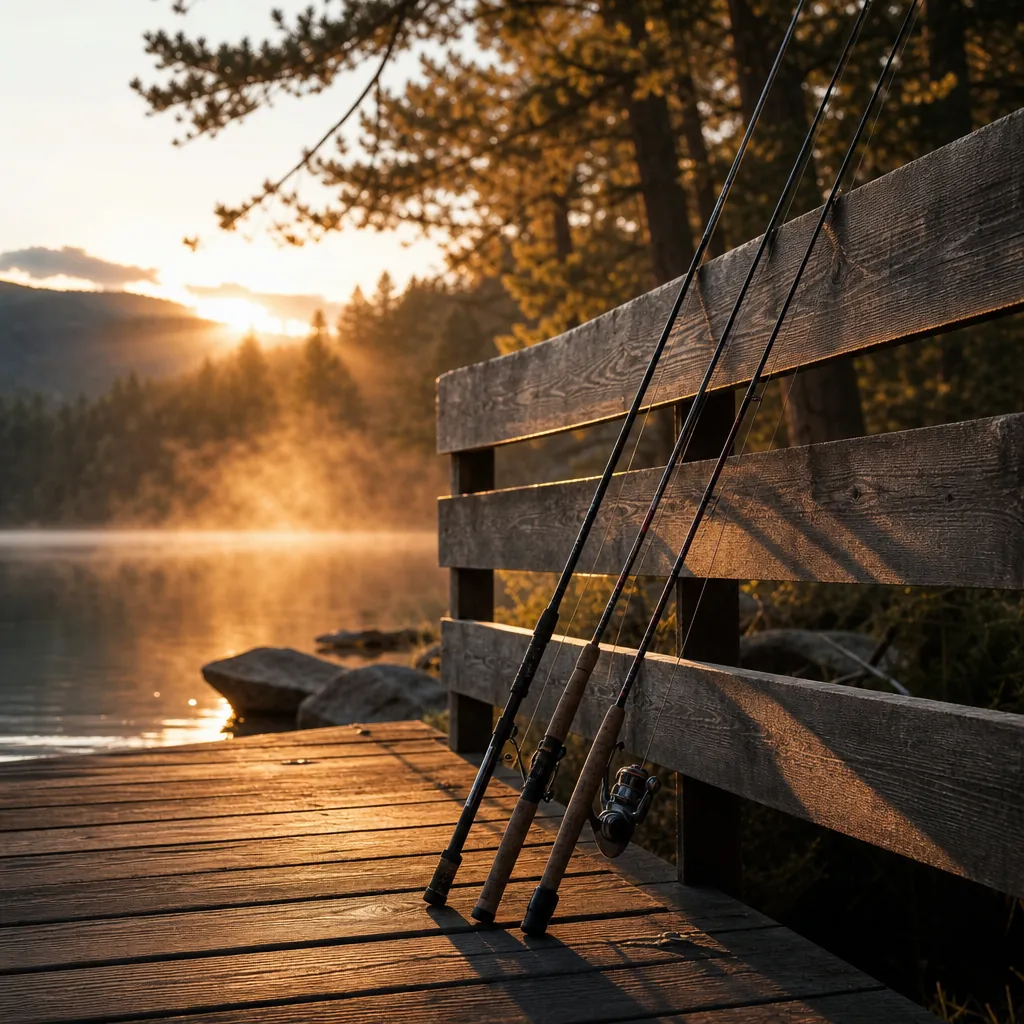
Rod Material: Graphite vs. Fiberglass vs. Composite
The blank — the actual rod body — is where material choice makes the biggest real-world difference. Three materials dominate the market.
Graphite
Graphite (technically carbon fiber) is the modern standard for performance rods. It’s light, stiff, and highly sensitive — you’ll feel a fish nudge a jig 30 feet down in 15 feet of water. The tradeoff is that graphite is more brittle than fiberglass. Slam a graphite rod in a car door or step on it and you’ll likely crack it. Higher-modulus graphite (IM7, IM8, IM10 are common designations) is stiffer and lighter, but also more expensive and slightly more fragile. For most technique-specific fishing — bass, walleye, inshore saltwater — graphite is the right call. Check out a range of graphite fishing rods on Amazon to see what fits your budget.
Fiberglass
Fiberglass rods are heavier and slower than graphite, but they’re nearly indestructible and have a natural moderate action built right into the material. They’re the classic choice for crankbait fishing — the inherent flex keeps fish from throwing treble hooks — and they’re excellent for beginners who are harder on gear. A good fiberglass rod is also significantly cheaper than a comparable graphite blank. If you’re teaching a kid to fish or you fish in situations where rods take a beating, fiberglass deserves serious consideration.
Composite
Composite rods blend graphite and fiberglass, trying to get the best of both worlds: sensitivity closer to graphite, durability closer to fiberglass. The result is genuinely useful — composites make excellent all-around rods for anglers who want one stick to do many jobs. Many of the best composite bass fishing rods sit in the $50–$120 range and punch well above their weight class.
Handle Types and Reel Seats: Comfort Matters More Than You Think
Handles don’t sound exciting, but after a six-hour day on the water, an uncomfortable grip will remind you why they matter.
Cork handles are the traditional choice — lightweight, warm in cold weather, and they transmit vibration well (which helps with sensitivity). Quality cork is premium stuff; cheap cork crumbles over time. EVA foam handles are more durable, easier to clean, and better at absorbing grip pressure over long sessions. They’re also more resistant to wear and weather. Most bass rods use split-grip designs (two separate sections of handle material) to save weight and improve sensitivity through direct hand contact with the blank. Full-grip handles are more common on spinning rods aimed at beginners and on rods used for live-bait or bottom fishing where you’re not holding the rod constantly.
Reel seats should lock your reel down firmly with no wobble. Graphite reel seats are light; aluminum or stainless are more durable. Trigger-style reel seats on casting rods give you a natural index-finger grip point. Don’t overthink this, but do wiggle your reel in the seat before you buy — if it rattles in the store, it’ll drive you nuts on the water.
Matching Rod to Species and Technique: Practical Recommendations
All the specs above are only useful when you connect them to what you’re actually fishing for and how you’re fishing. Here’s how that plays out in practice.
Bass Fishing (Spinning Setup)
For finesse techniques — drop shot, ned rig, shaky head — you want a 6’8″ to 7’1″ medium-power fast-action spinning rod paired with 8–10 lb braided line and a fluorocarbon leader. Look for a medium fast-action spinning rod for bass in the $50–$100 range and you’ll be shocked how well they perform.
Bass Fishing (Baitcasting Setup)
For power techniques — flipping jigs, punching heavy cover, big swimbaits — step up to a medium-heavy or heavy 7’+ fast-action baitcasting rod. The extra length gives you leverage to move big fish, and the stiffer blank drives hooks through thick plastic and into a bass’s tough jaw.
Trout and Panfish
A 5’6″ to 6’6″ ultralight or light spinning rod is the classic tool. These fish are small and the fun is in the fight — a rod with too much backbone turns a 12-inch rainbow into a non-event. Pair it with 4–6 lb monofilament or light fluorocarbon and you’re set.
Inshore Saltwater (Redfish, Snook, Flounder)
Medium-heavy 7′ spinning rods dominate inshore saltwater. Salt is brutal on gear, so pay attention to guide material — look for corrosion-resistant guides (stainless steel frames, aluminum oxide or silicon carbide inserts). A medium-heavy inshore spinning rod rated for 10–20 lb line will handle the majority of nearshore situations on the Gulf or East Coast.
Crankbait Fishing (Any Species)
This is the one situation where you specifically want a moderate or slow-action rod — fiberglass or composite preferred. The rod loads up during the retrieve and acts as a buffer on the strike, preventing fish from using the lure’s treble hooks as leverage to throw the bait. A dedicated crankbait rod is a specialty item, but once you fish one, you’ll understand why tournament anglers swear by them.
Common Mistakes When Buying a Fishing Rod
- Buying a rod before a reel: Your rod and reel are a system. Buy them together or at least confirm they’re balanced — a heavy reel on a light rod feels terrible and kills sensitivity.
- Ignoring the lure weight rating: Every rod has a printed lure weight range on the blank. If you’re throwing lures outside that range regularly, you’re either wasting the rod’s potential or risking a break.
- Overspending on your first rod: A $60–$100 rod from a reputable brand will outfish a $300 rod in the hands of someone who’s still learning technique. Skills beat gear every time at this stage.
- Chasing the highest modulus graphite available: Ultra-high-modulus blanks are incredibly sensitive — and incredibly easy to crack if you pinch them in a car door, step on a tip, or high-stick a big fish. Beginners should stick to mid-modulus blanks.
- Buying one rod and trying to do everything with it: Eventually you’ll want at least two rods — one spinning setup for finesse work, one casting rod for power techniques. Don’t try to make a single medium-heavy rod handle every situation perfectly.
Final Thoughts: Start Simple, Fish More
The best rod is the one you actually have on the water. If you’re just getting started, grab a quality beginner spinning rod in the medium to medium-heavy range, 6’6″ to 7′ long, fast action — and go fish. You’ll learn more in three outings than in three hours of reading spec sheets. As you develop a feel for the techniques you love and the fish you chase most, you’ll naturally start to understand exactly what you need in your next rod. That’s when the more specialized gear starts to pay off. Until then, keep it simple, keep the line wet, and trust the process.