
Disclosure: BestFishingReviews.com earns a commission on qualifying purchases made through affiliate links in this article, at no extra cost to you.
Buying your first fishing boat is one of those decisions that feels simple until you’re actually standing on a dealership lot or scrolling through a hundred Craigslist listings at midnight. There are more boat types than most beginners realize, the price ranges are wild, and nobody warns you about the costs that kick in after you drive it home. This guide cuts through all of that. We’ll walk you through every major boat type, what you should realistically budget, the new-vs-used debate, and all the ownership costs that dealers conveniently forget to mention — so your first boat puts you on the water instead of putting you in a hole.
See current price & availability on AmazonCheck on Amazon →The Main Types of Fishing Boats (And Who They’re Actually For)
Before you talk money, you need to know what you’re shopping for. The “best” fishing boat depends entirely on where you fish and how you fish. Here’s an honest breakdown of the five main options a first-time buyer will encounter.
Jon Boats
A jon boat is a flat-bottomed aluminum skiff — simple, tough, and cheap to own. They range from tiny 10-footers you can carry on a truck bed to serious 18-foot rigs with livewells and rod lockers. Jon boats shine in shallow rivers, farm ponds, and calm lakes. They’re not made for open water or heavy chop, but for most freshwater fishing in the US, they’re more than enough boat. Parts are cheap, repairs are easy, and you can buy a used one for less than a used car. If you’re new to boating and not sure where this hobby is headed, a jon boat is the lowest-risk entry point there is.
Bass Boats
Bass boats are purpose-built tournament fishing machines — low-profile fiberglass hulls, powerful outboards, trolling motors up front, and more rod storage than you’ll ever fill. They’re fast, sleek, and genuinely fun. They’re also expensive to buy, expensive to insure, expensive to maintain, and overkill for a first-time buyer who hasn’t figured out whether they even like waking up at 4 a.m. to fish a tournament. If you’re dead-set on bass fishing and have a healthy budget, there’s a used bass boat with your name on it — but go in with eyes open on the ongoing costs.
Aluminum V-Hull Boats
An aluminum V-hull splits the difference between a jon boat and a bass boat. The V-shaped hull handles chop and waves far better than a flat-bottom jon boat, making it a solid choice for larger lakes, reservoirs, and even calm coastal bays. You get a more comfortable ride, decent storage, and enough room for two or three anglers. Weight and draft are still manageable. For the all-around beginner who wants versatility without the price tag of fiberglass, a aluminum fishing boat setup is hard to beat.
Fishing Kayaks
Fishing kayaks have exploded in popularity for good reason — they’re affordable, require no trailer, no registration in most states, and can access water that a motorized boat never could. Sit-on-top models in the 12-to-14-foot range are the sweet spot for most anglers. The tradeoffs are real: you’re limited in gear, limited in range, and limited by weather and fatigue. But if you’re fishing small ponds, slow rivers, or coastal flats on a budget, a quality fishing kayak might be all the boat you need — at least to start.
Inflatable Fishing Boats
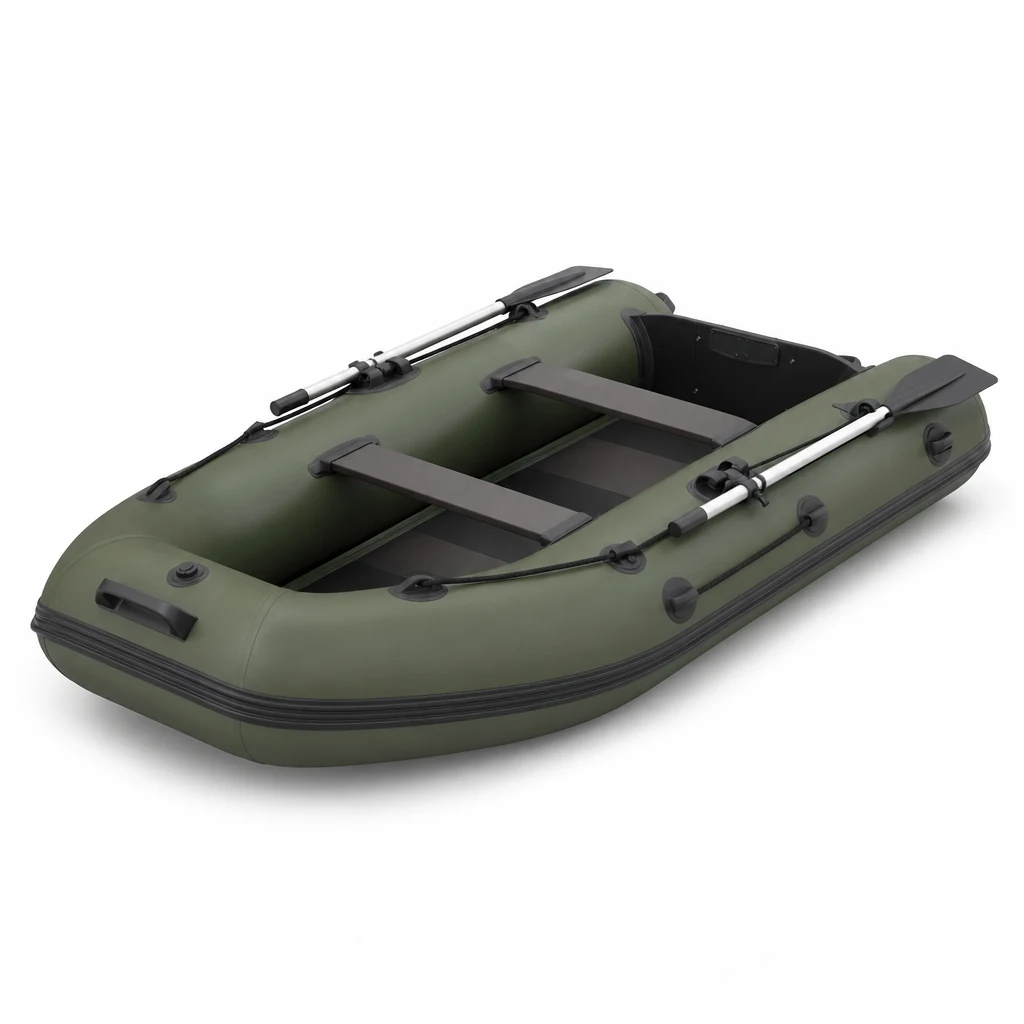
Modern inflatables aren’t the cheap pool toys they used to be. Heavy-duty PVC or Hypalon inflatables can handle small outboards or electric trolling motors, store in a bag in your trunk, and work well on calm lakes and slow rivers. They’re the right call for anglers with zero storage space, no tow vehicle, and a limited budget. The ceiling is lower than any hard-sided boat — they’re not fast, not great in current, and not for open water — but for casual fishing in calm conditions, they get the job done.
Realistic Budgets: What Things Actually Cost
Let’s talk numbers — real ones. Here’s a rough framework for what you’ll spend getting on the water in each category, assuming you’re buying used (which we’ll address in a moment):
- Fishing kayak: $400–$1,200 used, $800–$2,500 new. Add a paddle, PFD, and basic gear and you’re in for under $1,500 all-in.
- Inflatable boat: $200–$600 for the boat; add a trolling motor, battery, and charger for another $400–$700.
- Jon boat (10–14 ft): $500–$2,500 used with a small motor. New rigs with motor and trailer run $3,000–$6,000.
- Aluminum V-hull (14–17 ft): $3,000–$8,000 used with a moderate outboard. New rigs can run $10,000–$18,000.
- Used bass boat: $6,000–$15,000 for a decent older fiberglass rig with a working motor. New bass boats start around $25,000 and climb fast.
One rule of thumb worth burning into your brain: whatever you think the boat will cost to own annually, double it. Maintenance, fuel, repairs, and gear add up faster than any first-timer expects.
New vs. Used: The Honest Truth
For a first-time buyer, used is almost always the smarter play — with some conditions attached. Here’s the honest case for each side.
Buy used if: You’re not sure yet how much you’ll actually use the boat, you’re working with a tight budget, or you want to learn on something forgiving. Used boats depreciate slowly once they’re past the initial drop, and a well-maintained aluminum boat from the 1990s can be as fishable as a new one. Inspect the hull carefully for cracks, stress fractures, and corrosion. Run the motor before you buy — always. Check the trailer axle, bearings, and bunks while you’re at it.
Buy new if: You’ve already got experience, you know exactly what you want, you want the warranty, and you can genuinely afford it without straining. Dealers also bundle package deals — boat, motor, trailer — that can represent solid value when interest rates are reasonable. Just don’t buy new on a credit card or at a payment that makes you nervous.
One middle-ground option worth considering: certified pre-owned programs through dealers. You get a inspected, reconditioned boat with some warranty coverage at a price below new. It’s not always available, but it’s worth asking about.
The Costs Nobody Warns You About
The purchase price is just the entry fee. Here’s the full list of ongoing and one-time costs that catch new boat owners off guard:
Registration
Nearly every motorized boat in the US requires state registration. Fees vary by state — anywhere from $15 to $150 per year depending on where you live and the size of the boat. Non-motorized boats (kayaks, canoes, paddleboards) are exempt in most states, though a handful require registration regardless. Budget $30–$100 per year and check your state’s DNR or Fish & Wildlife website for the exact rules.
Insurance
Boat insurance isn’t legally required in most states, but it’s genuinely dumb to skip. A basic liability policy on a small aluminum boat or jon boat runs $100–$200 per year. Insuring a fiberglass bass boat with a high-horsepower motor can run $300–$600 or more annually. If you’re financing, your lender will require it. Even if you’re paying cash for a cheap used boat, consider at least a liability policy — one collision or injury claim can dwarf what you saved skipping coverage.
Storage
If you don’t have a garage or driveway that fits a boat and trailer, storage costs money. Dry storage at a marina runs $50–$200 per month depending on your area. Covered rack storage (for smaller boats) is often cheaper. Outdoor storage lots can run $30–$100 per month. Factor this into your budget before you fall in love with a 20-foot rig you have nowhere to put.
Maintenance and Fuel
Outboard motor service — oil, spark plugs, impeller, gear lube — runs $150–$400 per year if you do some of it yourself, more at a shop. Fuel is whatever fuel is. A small 25 HP outboard is economical; a 200 HP bass boat motor is not. Add in hull cleaning, trailer maintenance (bearings, lights, tires), and the occasional repair, and a reasonable annual maintenance budget for a mid-sized motorized boat is $500–$1,500 per year, more for older or larger rigs.
Motor Sizing: Don’t Overpower and Don’t Underpower
Every boat hull has a maximum horsepower rating stamped on its capacity plate — do not exceed it. That’s a hard limit. Within that limit, the right motor size depends on how you use the boat.
For a 14-foot jon boat or small aluminum V-hull, a 15–25 HP outboard is typically plenty. It’ll get you where you’re going, burn modest fuel, and cost less to run and repair. Going bigger just to go fast usually ends in a boat that’s uncomfortable to run at high speed anyway.
For a 16–18 foot aluminum V-hull or mid-size boat, 40–75 HP is a solid range. You’ll get to cruising speed, handle some chop, and still have a motor that doesn’t drink fuel like a thirsty horse.
Most beginners should also budget for a electric trolling motor — it’s how you actually fish once you’re in position. For jon boats and kayaks, it can also be your primary propulsion on calm water. Match the thrust rating to your boat size: roughly 2 lbs of thrust per 100 lbs of loaded boat weight is a useful starting rule.
The Trailer Question
If you’re buying a kayak or inflatable, skip this section — you don’t need one. For everyone else: you need a trailer, and it’s not an afterthought.
Most used boat sales include a trailer, which is convenient but not always a blessing. Inspect it harder than the boat. Look for rust on the frame, check the wheel bearings (spin the wheel — it should roll freely and quietly), look at the tire sidewalls for cracking, and test all the lights. A rusted-out trailer with bad bearings can destroy a wheel on the highway or launch your boat into another car. Replacing a boat trailer runs $800–$2,500 depending on size and quality.
Also consider your tow vehicle. A small jon boat or kayak trailer can be pulled by almost any full-size car or crossover. A 1,800-pound aluminum V-hull rig needs a truck or SUV with a proper tow rating. A 4,000-pound fiberglass bass boat and trailer needs a capable half-ton truck, minimum. Check your vehicle’s tow rating in the owner’s manual — not on a forum, in the actual manual — before you commit to a boat that outweighs what you can safely haul.
While you’re at it, pick up a good set of tie-down straps and a quality trailer lock before your first trip. These are small costs that prevent large disasters.
How to Choose the Right Boat for You
Run through this short checklist before you spend a dollar:
- Where will you fish, specifically? Small ponds and rivers favor jon boats and kayaks. Large reservoirs and open bays favor V-hull aluminum or fiberglass. Know your water before you know your boat.
- Who’s coming with you? A kayak is a solo vehicle. If you want to take your kids or a buddy, you need a boat with real capacity.
- Do you have somewhere to put it? Storage logistics are real. Don’t buy a boat-and-trailer combo that won’t fit your life.
- What’s your realistic total budget — not just the purchase price? Factor in registration, insurance, storage, and at least one year of maintenance before you decide what you can afford to buy.
- How often will you actually use it? Be honest. If you’re fishing ten days a year, a $15,000 bass boat doesn’t make financial sense. A solid used jon boat or a quality kayak does.
One more thing worth saying plainly: whatever boat you pick, make sure you have the right Coast Guard-approved life jackets on board for every person before you leave the ramp. Federal law requires it. So does common sense.
Final Thoughts
Your first fishing boat doesn’t have to be your dream boat — it just has to get you on the water without breaking your finances or your spirit. Start with a type and size that matches where you actually fish, buy used unless you have a compelling reason not to, and budget honestly for everything the purchase price doesn’t cover. A well-chosen used jon boat or aluminum V-hull can deliver years of great fishing for less than you’d spend on a season of guided trips. Get out there, learn on the water, and upgrade later when you know exactly what you want.
Gear We Recommend