Disclosure: BestFishingReviews.com is reader-supported. When you buy through links on our site, we may earn an affiliate commission at no extra cost to you.
Rod holders are one of those things you pay way too much for at a tackle shop, then immediately regret when you realize a weekend afternoon and twenty bucks in hardware-store parts would have done the same job. Whether you’re rigging up a bank fishing spot, cleaning out the garage, or outfitting a kayak, there’s a DIY rod holder solution that fits your situation. None of these builds require advanced woodworking skills or a garage full of specialty tools. If you can use a saw, a drill, and a tape measure, you’re qualified. We’ve put together five proven builds — with materials lists and tips — so you can pick the one that fits your setup and get it done before Sunday afternoon rolls around.
See current price & availability on AmazonCheck on Amazon →How We Picked
These five builds were chosen because they cover the most common rod-storage and rod-holding scenarios anglers actually deal with: bank fishing, garage storage, kayak fishing, jon-boat fishing, and truck hauling. Each one uses readily available materials, costs under $40 to build, and can realistically be finished in a single weekend session. We prioritized builds that are sturdy, rod-friendly (no scratching or bending guides), and adaptable to different rod lengths and quantities.
1. PVC Bank Rod Holder
This is the classic, and it’s classic for a reason. A bank fishing rod holder made from PVC pipe costs almost nothing, takes about 20 minutes to build, and holds your rod at exactly the angle you want while you wait for a bite. You’re basically making a large spike from a sharpened wooden or rebar stake, then capping it with a length of 1.5- or 2-inch PVC pipe that holds your rod butt. Cut the PVC to about 18–24 inches, cap the top with a slip cap drilled with a small drainage hole, and use a hose clamp or PVC cement to attach it to your stake. Angle the pipe back slightly at about 30–45 degrees so the rod sits at a natural fighting angle. You can build four or five of these for the price of one name-brand bank holder at the tackle shop.
Best for: Bank catfish, carp, or surf anglers who want inexpensive, portable rod holders they don’t mind leaving in the mud.
Get your PVC pipe and fittings — you’ll want slip caps, elbows if you’re building an angled version, and maybe a coupler or two.
- Pro: Dirt cheap — build a six-pack for under $15 total
- Pro: Stakes into almost any soft ground; no drilling required
- Pro: Fully weatherproof and easy to replace if one gets lost or cracked
- Con: Doesn’t work on rocky shorelines or hardpack
- Con: No adjustability once it’s in the ground
- Con: Not great for heavy surf setups without a longer, thicker stake
2. Wall-Mounted Garage Rod Rack
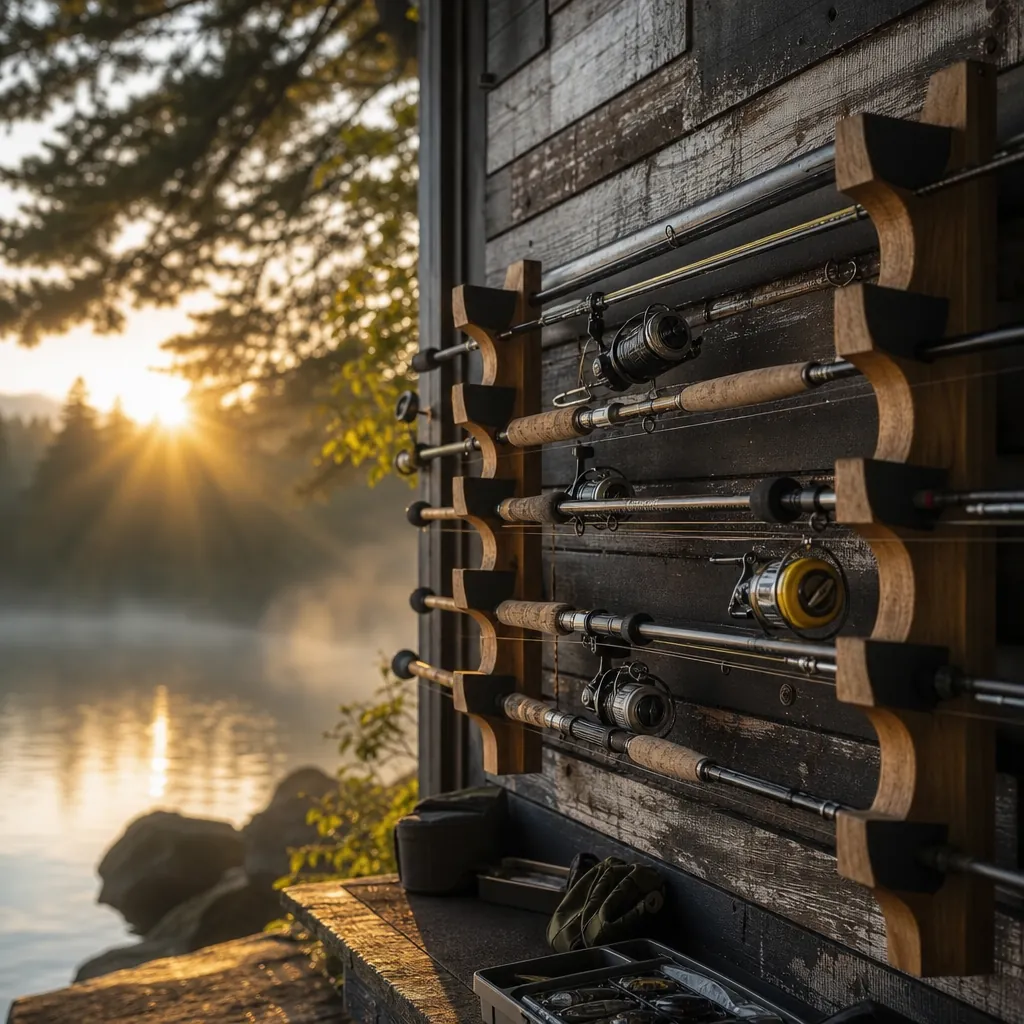
If you’ve got rods leaning against the wall, hanging off a workbench, or balanced across the hood of your car in the garage, this build will change your life. A simple wall-mounted rod rack uses a pair of horizontal wooden boards — typically 1×4 or 1×6 pine — mounted at two heights on the wall. The lower board gets holes drilled at an angle to cradle the rod butts, and the upper board gets smaller holes or foam-lined notches to hold the rods near the tip section without putting pressure on the guides. Line the holes with foam pipe insulation or rod-holder foam to prevent scratching. Space the holes about 4 inches apart, and a 4-foot board will hold eight to ten rods easily. Total cost: around $15–$20 in lumber and foam.
Best for: Anglers with a dedicated garage or shed space who want to store 8–20 rods safely off the floor.
- Pro: Holds a large number of rods in a compact footprint
- Pro: Foam lining protects guides and rod blanks from damage
- Pro: Can be painted or stained to look sharp in a clean garage
- Con: Requires studs or proper wall anchors — don’t skip this step
- Con: Fixed installation; not portable
- Con: Longer rods may need ceiling clearance adjustment
3. Kayak DIY Rod Holder
Kayak rod holders from manufacturers often run $30–$60 each, and most kayaks come with only one or two flush-mount positions — never enough. The good news is that a flush-mount PVC build fits right into most kayak scupper holes or can be surface-mounted with a simple backing plate. For a flush-mount version, buy a standard 2-inch flush-mount rod holder tube (the PVC kind sold for boats), cut it to length, and secure it through the kayak deck with a backing plate made from a small piece of ABS plastic or even a cutting board scrap. Use stainless steel hardware throughout — anything that rusts on a kayak becomes a permanent fixture fast. For a scupper-mount version, a length of 1.5-inch PVC with a slight angle cut on the bottom can be wedged into a rear scupper hole and adjusted by wrapping the base with electrical tape until it fits snug. Add a marine-grade stainless hardware kit to keep everything from corroding out from under you after a season on the water.
Best for: Kayak anglers who need to add rod-holding capacity without buying expensive aftermarket accessories.
- Pro: Keeps rods secure and out of the way while paddling
- Pro: PVC construction is fully waterproof and UV-resistant
- Pro: Scupper-mount version requires zero drilling
- Con: Flush-mount version does require cutting into your kayak deck — measure twice
- Con: Angle and position take some trial and error to get right
- Con: Not ideal for very long rods or two-piece rods with heavy rear sections
4. Jon-Boat Rail Mount Rod Holder
Jon boats are workhorses, and they deserve practical rod holders that can take a beating. The easiest approach here is a clamp-on rail mount build using a rail clamp base — available at most marine supply shops and online — combined with a PVC rod holder tube you cut and fit yourself. Pick up a 1-inch or 1.5-inch rail clamp base that matches your gunwale rail diameter, then cement a 2-inch ID PVC tube into the clamp’s socket at the angle you want. Wrap the inside of the tube with foam and you’re done. If your jon boat has flat aluminum gunwales instead of round rail, you can bolt a short wooden block to the gunwale lip to create a mounting surface, then attach the clamp base to the block. The whole rig costs about $10–$15 per holder and takes 30 minutes including drying time for the PVC cement.
Best for: Jon-boat anglers who want removable rod holders that don’t require permanent modification to the boat.
- Pro: Clamp-on design installs and removes in seconds
- Pro: Sturdy enough to hold a rod while trolling at slow speeds
- Pro: Position along the rail is fully adjustable
- Con: Rail clamp bases add some cost compared to the pure PVC builds
- Con: Clamps can loosen over time with vibration — check and retighten periodically
- Con: Not compatible with every gunwale profile without a spacer block modification
5. Magnetic Truck-Bed Rod Holder
Transporting rods in a truck bed without holders means guide damage, tangled lines, and broken tips — ask anyone who’s done it for a season. A magnetic truck-bed rod holder solves all of that with zero drilling. The build uses a pair of strong neodymium magnets mounted inside a foam-lined PVC cradle. Cut two sections of 3-inch PVC pipe at about 6 inches long, split them lengthwise to create a U-shaped cradle, line them with adhesive-backed foam tape, then epoxy or bolt a heavy-duty neodymium magnet to the flat back of each cradle. The magnets stick to the steel bed of your truck, the cradles hold your rod blanks gently but firmly, and the whole thing lifts off cleanly when you unload. Pick up a set of heavy-duty neodymium magnets rated for at least 50 lbs pull force so they don’t slide around on rough roads. Use two cradles per rod spaced about 18 inches apart, and run a bungee cord across the rods for highway driving.
Best for: Pickup truck anglers who want a clean, no-drill rod transport solution that installs in under five minutes.
- Pro: Zero permanent modification to your truck
- Pro: Foam lining protects rod blanks and guides during transport
- Pro: Takes about 30 seconds to set up or break down at the ramp
- Con: Only works on steel truck beds — aluminum beds won’t hold the magnets
- Con: Bungee backup is essential at highway speeds; don’t skip it
- Con: Magnets can pick up metal shavings and debris from the truck bed over time
Quick Comparison
- PVC Bank Holder: Best for bank fishing — cheapest build, fully portable, stakes into soft ground
- Garage Wall Rack: Best for home storage — holds the most rods, keeps everything organized and off the floor
- Kayak DIY Holder: Best for kayak anglers — no-drill scupper option available, keeps rods secure while paddling
- Jon-Boat Rail Mount: Best for jon boats — removable clamp-on design, adjustable position, no permanent holes
- Magnetic Truck-Bed Holder: Best for truck transport — zero drilling, fast setup, gentle on rod blanks
Bottom Line
Any one of these five builds will outperform doing nothing, and most of them will outperform cheap store-bought holders too. Pick the one that matches where you fish and how you transport your gear, grab your materials this weekend, and spend the hour or two it takes to build it right. Your rods — and your back — will thank you the next time you show up at the water fully organized and ready to fish instead of untangling a pile of rods from the back seat.