Disclosure: BestFishingReviews.com participates in the Amazon Associates program and may earn a commission on qualifying purchases made through links in this article, at no extra cost to you.
You just pulled something up from the deep and it’s flopping around in the net. Now what? Knowing exactly what you’ve caught matters — for legal reasons (size and bag limits vary by species), for deciding whether to keep or release, and honestly, just for the satisfaction of knowing your quarry. North America’s freshwater systems hold an incredible variety of fish, and a surprising number of anglers still mix up species they encounter every single weekend. This guide walks you through ten of the most common freshwater fish you’ll find across the country, what makes each one distinct, where they live, and how to avoid the most common identification mistakes. Keep it bookmarked on your phone for the next time something unfamiliar hits your hook.
See current price & availability on AmazonCheck on Amazon →The Bass Family: Largemouth vs. Smallmouth
These two are the kings of recreational freshwater fishing, and while experienced anglers tell them apart in a second, newcomers mix them up constantly. Here’s how to sort it out fast.
Largemouth Bass
The largemouth is named for exactly what you’d think — its mouth is enormous, extending past the rear edge of the eye when closed. The body is olive-green to dark green on the back, fading to a whitish belly, with a bold, ragged horizontal stripe running along the lateral line. The dorsal fin is nearly divided into two separate sections. Largemouth love slow, warm, weedy water — shallow coves, lily pad flats, flooded timber, and murky reservoirs. If you’re fishing vegetation in water under 15 feet, there’s a good chance you’re after largemouth. To make sure you’re rigged for them, check out some largemouth bass fishing lures suited to their weedy habitat.
Smallmouth Bass
The smallmouth’s jaw stops at or before the rear edge of the eye — that’s the quickest check. Coloring runs bronze to brownish-green with vertical dark bars on the sides (not a horizontal stripe). Red eyes are common and actually a reliable field mark. Smallmouth prefer clear, cool, rocky lakes and fast-moving rivers. Think gravel bars, rocky points, and current seams. They fight pound-for-pound harder than largemouth, which is why so many anglers specifically target them. If the water’s cold and clear and you’re near rocks, suspect smallmouth before you suspect largemouth.
The Panfish Group: Bluegill, Crappie, and Sunfish
The word “sunfish” causes more confusion than almost anything else in freshwater ID. Technically, sunfish is a family (Centrarchidae) that includes bass, crappie, and bluegill — but most anglers use “sunfish” to mean the small, colorful, deep-bodied panfish that aren’t bluegill or crappie. Here’s how to break it down.
Bluegill
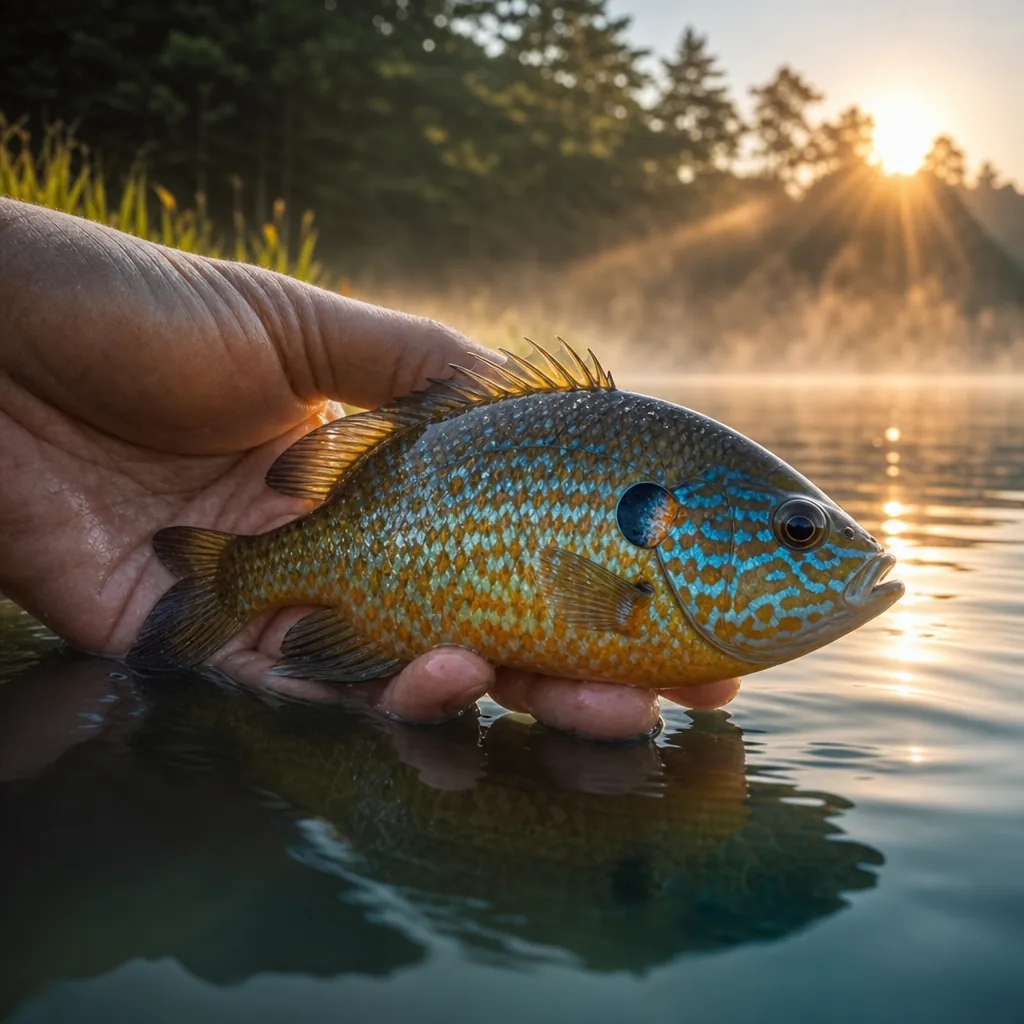
Bluegill are deep-bodied and laterally compressed — like someone squeezed them from both sides. Look for a dark blue-black “ear flap” (the opercular flap) at the rear of the gill cover. The breast and belly of spawning males turn brilliant orange. Vertical dark bars run along the sides. Bluegill are found in nearly every warm, weedy lake, pond, and slow river in the country, often in huge numbers near docks and submerged brush.
Crappie (Black and White)
Crappie are larger-mouthed than bluegill, with a more silvery, speckled appearance. Black crappie have random dark speckles across a silvery-green body and prefer clearer water. White crappie have distinct vertical bars and are more tolerant of murky conditions. Both species love submerged brush piles, bridge pilings, and timber in 8–20 feet of water. If you’re getting bites near structure in deeper water than bluegill typically hold, crappie are a strong bet.
Other Sunfish (Pumpkinseed, Green Sunfish, Redear)
Pumpkinseed sunfish have a bright orange-red spot at the tip of the ear flap — not dark like bluegill. The body is covered in orange and blue spots, making them arguably the most colorful freshwater fish in North America. Green sunfish are stockier, with a larger mouth than other panfish and a yellowish-green tint. Redear sunfish (shellcrackers) look similar to bluegill but have a red or orange edge on that ear flap rather than solid black. If you’re catching what looks like a bluegill but something seems slightly off about the coloring, check that ear flap first — it tells you most of what you need to know.
Walleye and Yellow Perch: The Great Lakes Staples
Walleye
Walleye are one of the most prized table fish in North America, and their appearance is distinctive once you know what to look for. The most immediately obvious feature is the eyes — large, glassy, and opaque-looking, almost like a marble. That milky appearance comes from a reflective layer called the tapetum lucidum, which gives walleye exceptional low-light vision. The body is olive-gold with brassy mottling, and the lower tip of the tail fin has a distinctive white patch. The first dorsal fin has sharp spines with a black blotch at the rear base. Walleye live in large, clear to slightly turbid lakes and rivers, often in the northern tier states and Canada. They’re notorious for staging near rocky structures and river current breaks at dawn and dusk.
Yellow Perch
Yellow perch are easy — bright yellow body, six to eight dark vertical saddle bars across the back and sides, and orange-tinged lower fins on adults. They’re a smaller fish, typically 6–12 inches, but they school in large numbers and are fantastic eating. Perch love the same general habitat as walleye — clear, cool, mid-depth lakes — and the two species are often caught together. If you’re catching small perch while targeting walleye, you’re probably in the right zone, just need to go deeper or slower.
Northern Pike: Hard to Miss, Easy to Mishandle
Northern pike are long, torpedo-shaped ambush predators with a duck-bill snout full of teeth. The coloring is dark green to olive with rows of light yellow or cream-colored bean-shaped spots along the flanks. The dorsal and anal fins are set far back near the tail, which is a key structural feature shared with muskellunge (muskie). The most common confusion is pike vs. muskie. Here’s the fast rule: pike have light spots on a dark background; muskie have dark spots or markings on a light background. Pike also have fully scaled cheeks, while muskie cheeks are only half-scaled. Pike are found in weedy bays, river backwaters, and shallow lake edges — anywhere they can ambush prey. Handle with care; those teeth are no joke, and a fish grip tool is a smart investment before you target them.
Channel Catfish: The Whiskered Bottom Dweller
Channel catfish are the most widely distributed catfish species in North America and a favorite for bank anglers everywhere. They have smooth, scaleless skin that ranges from blue-gray to olive-brown, deeply forked tails, and the signature barbels (“whiskers”) around the mouth. Smaller channel cats often have scattered dark spots on the sides that fade as the fish ages. The easiest confusion is channel cat vs. blue catfish — blue cats are larger, have a more uniform slate-blue coloring, and have a straight (not rounded) anal fin with more rays. Channel cats prefer rivers with moderate current, deep holes, and gravel or rocky bottoms, though they adapt well to reservoirs and ponds. For bank fishing setups, a good catfish rod and reel combo makes a real difference on bigger fish.
The Trout Family: Rainbow, Brown, and Brook
Trout are the crown jewels of freshwater fishing in many parts of the country, and all three of these species can appear in overlapping waters, especially in stocked systems. Getting them right matters both for regulations and for bragging rights.
Rainbow Trout
Rainbow trout have a pink-to-red lateral band running along the midline of the body, small black spots across the back, dorsal fin, and tail, and a generally silver to olive-green body. Wild rainbows in fast streams are vivid; hatchery fish tend to be more washed out. Rainbows are the most commonly stocked trout species across the US. They prefer cold, highly oxygenated water — swift mountain streams and cold tailwaters below dams. To match what they’re eating, a selection of trout fishing flies and lures is worth having in your vest.
Brown Trout
Brown trout have a golden-brown to tan background color with large dark brown or black spots, many of which are surrounded by pale halos. Red or orange spots with halos are also present, especially along the lateral line. The tail is less spotted than a rainbow’s and barely forked. Browns are generally more wary and harder to catch than rainbows, which is why experienced trout anglers chase them specifically. They tolerate slightly warmer water than rainbows and often persist in streams where rainbows disappear by midsummer.
Brook Trout
Brook trout are technically a char, not a true trout, but most anglers lump them together. They’re stunning fish — olive to dark green backs with worm-like yellow markings (called vermiculations), red spots with blue halos along the sides, and a belly that turns brilliant orange-red on spawning males. The lower fins have a white leading edge followed by black, then a red-orange stripe — that fin pattern alone identifies them instantly. Brook trout need the coldest, cleanest water of any common trout species. If you’re deep in a remote headwater stream in the Northeast or Appalachians and you’re catching trout, they’re almost certainly brookies. A good ultralight spinning rod for trout is all you need for these smaller fish in tight quarters.
Common Identification Mistakes (And How to Avoid Them)
Even experienced anglers make these mix-ups. Here’s a quick hit list of the most common ones:
- Largemouth vs. smallmouth bass: Check the jaw — does it extend past the eye? Largemouth. Short of the eye? Smallmouth. Then look for the horizontal stripe (largemouth) vs. vertical bars (smallmouth).
- Pike vs. muskie: Light spots on dark = pike. Dark markings on light = muskie. When in doubt, check the cheek scaling.
- Bluegill vs. other sunfish: Look at the ear flap. Solid dark blue-black = bluegill. Orange or red tip = pumpkinseed or redear.
- Black crappie vs. white crappie: Speckles scattered randomly = black crappie. Distinct vertical bars = white crappie. Black crappie also have 7–8 dorsal spines; white crappie have 5–6.
- Rainbow vs. brown trout: Pink lateral band = rainbow. Halo spots with red dots = brown. Brown trout tails are nearly unspotted; rainbow tails are heavily spotted.
- Channel catfish vs. blue catfish: Check the anal fin — rounded with fewer rays = channel. Straight-edged with more rays = blue cat.
- Walleye vs. sauger: Sauger are smaller walleye relatives with distinct dark blotches on the dorsal fin and no white tail tip. If that tail tip is white, it’s a walleye.
Field Tools That Make Identification Easier
You don’t need to carry an encyclopedia on the water. A few practical tools help more than anything else. First, your state’s fishing regulations booklet has species ID charts — most are free and available as PDFs. The iNaturalist and FishBrain apps both have photo ID features that work surprisingly well in good light. For printed reference, a laminated freshwater fish ID card that fits in a tackle box is worth every penny. And if you’re targeting new species in unfamiliar water, a freshwater fish identification field guide for your specific region covers local subspecies and color variations that generic national guides miss.
Beyond guides and apps, practice is the real teacher. Take a few seconds with every fish you catch before you release it. Note the jaw length, the fin placement, the spot patterns, the tail shape. After a few seasons, you’ll be the one at the boat ramp that other anglers are asking.
Habitat as Your First Clue
Before you even look at the fish, the water itself tells you a lot. Here’s a rough mental framework:
- Cold, clear, fast-moving streams: Trout (rainbow, brown, brook depending on region and elevation), smallmouth bass in larger flows.
- Cold, clear northern lakes: Walleye, yellow perch, smallmouth bass, northern pike in weedy shallows.
- Warm, weedy ponds and reservoirs: Largemouth bass, bluegill, crappie, channel catfish in deeper holes.
- Large rivers with current: Channel catfish, smallmouth bass, walleye, sauger, occasionally northern pike.
- Remote mountain headwaters: Brook trout almost exclusively in the East and upper Midwest.
When you combine habitat context with the physical features described above, you’ll narrow down possibilities fast. Most of the time, there are only two or three realistic candidates for what’s on your hook in any given spot — and the ID tips in this guide should settle it from there.
Putting It All Together
Fish identification doesn’t have to be intimidating. Run through a simple mental checklist: Where are you fishing? What does the body shape look like? Where’s the mouth in relation to the eye? What does the tail look like? What are the fins doing? Most of the time you’ll have your answer in under ten seconds. The ten species covered here account for the vast majority of what most freshwater anglers encounter across North America. Learn these, and you’ll handle 90 percent of what hits your line with confidence. The more time you spend on the water, the faster those details burn into memory — and there’s no better reason to go fishing than that.