Disclosure: BestFishingReviews.com earns a small commission on purchases made through links in this article at no extra cost to you.
A dragging anchor is one of those problems that sneaks up on you. One minute you’re dialed in on a perfect bass flat, the next you’re 80 yards downcurrent wondering what happened. Most anglers learn anchoring by trial and embarrassment, but it doesn’t have to go that way. Get the fundamentals right — the right anchor for your bottom type, the right amount of line, and the right attachment point on your boat — and you can hold position in everything from a glassy pond to a gnarly tidal river. Here’s how to do it properly, regardless of what the water throws at you.
See current price & availability on AmazonCheck on Amazon →Know Your Anchor Types Before You Buy
Not all anchors work on all bottoms. Using the wrong design is the number-one reason anglers drag. Here’s a plain-English breakdown of the four types you’ll actually encounter on a fishing boat.
Mushroom Anchor
Shaped exactly like its name, the mushroom anchor works by suction and dead weight on soft mud and silt bottoms — think ponds, slow backwaters, and protected coves. It’s the classic “small boat” anchor and it’s fine for calm conditions on mucky lake floors. It offers almost zero holding power on sand, gravel, or rock, so keep it where it belongs. Great for small jon boats and canoes in still water.
Fluke (Danforth) Anchor
The fluke anchor is the workhorse of recreational fishing. Those flat, pivoting flukes dig into sand and soft-to-firm mud with impressive holding power relative to its weight. It’s the go-to choice for bay boats, aluminum fishing boats, and center consoles. It folds flat for easy storage and holds well in wind and light current. Where it fails: heavy grass, rock, and loose shell — the flukes can’t bite in. If you fish coastal bays, tidal flats, or sandy lake bottoms, a Danforth-style fluke anchor should be your primary.
Grapnel Anchor
The grapnel looks like a small grappling hook — four or more tines radiating from a central shaft. It hooks into rock, gravel, heavy debris, and reef structure where flukes would just skid across the surface. It’s the right call for rocky rivers, tailwaters below dams, and Great Lakes structure fishing. The tradeoff: it can snag hard and be a real pain to retrieve. Many grapnels are built with breakaway wire rings so you can pull the tines straight under heavy load and free the anchor if it locks up.
River (Suitcase / Box) Anchor
River anchors — sometimes called suitcase anchors or box anchors — are flat, heavy, and designed to sit on the bottom like a paperweight rather than dig in. They work by sheer mass on hard, fast-moving water where no fluke or grapnel gets a reliable bite. You’ll see them on drift boats, bass boats on the Tennessee River, and guide boats chasing walleye in swift current. They’re heavy and awkward, but on current-swept gravel bars and cobble bottoms, nothing holds better.
Scope: The Rule That Actually Keeps You in Place
Scope is the ratio of anchor line you let out relative to the depth of water you’re anchoring in. This single variable matters more than anchor weight in most situations. Here’s the plain-numbers version:
- Calm, light-breeze conditions: 3:1 scope minimum. In 10 feet of water, let out at least 30 feet of line.
- Moderate wind or light current: 5:1 scope. That same 10-foot hole needs 50 feet of line.
- Heavy wind or strong current: 7:1 scope or more. In 10 feet of water, you may be letting out 70–100 feet of rode.
The reason scope works is geometry. A short, steep anchor line pulls the anchor up and out of the bottom. A long, shallow-angled line pulls the anchor horizontally, which is exactly how the flukes or tines are designed to load. Skimp on scope and you’re just dragging a hunk of metal across the bottom no matter how heavy it is.
Also worth noting: measure from the bow cleat or anchor roller down to the waterline, then add that vertical distance to your depth when calculating scope. On a bay boat with a high bow, that can add 3–4 feet you need to account for.
Use a combination of chain and nylon line (called “rode”) for best results. Even 3–6 feet of anchor chain at the bottom keeps the angle low and absorbs shock. Nylon anchor rope with chain leader kits are inexpensive and make a real difference.
Bow vs. Stern Anchoring — and Why It Matters
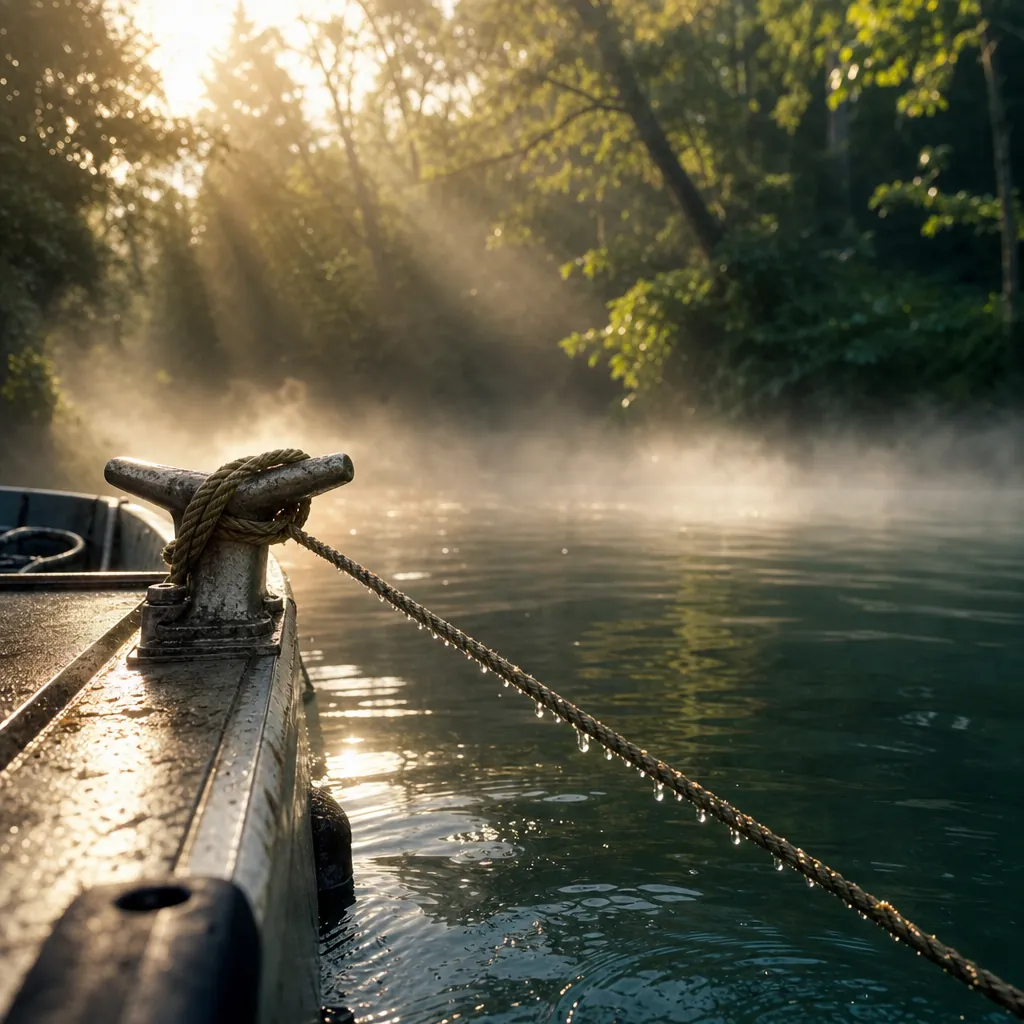
Where you tie off the anchor line changes everything about how your boat sits and how safe it is.
Always Anchor from the Bow in Most Situations
The bow is the narrowest, highest point of the boat — it’s designed to cut through waves and point into wind and current. When you anchor from the bow, the boat weather-vanes naturally, presenting its smallest profile to whatever is pushing on it. The result is a stable, predictable lie.
Anchor from the stern and things get dangerous fast. In any kind of chop or current, water can wash over a low transom and swamp the boat in minutes. This is a real and common cause of boating accidents. There’s almost no good reason to anchor a motorized boat from the stern in open water.
The Two-Anchor Technique for Current Fishing
River anglers who need to stay locked on a specific piece of structure — say, a current seam above a gravel bar — often run two anchors: one off the bow dropped upstream and one off the stern dropped downstream. This “Mediterranean moor” setup keeps the boat from swinging and lets you present baits in the exact lane you want. It takes practice to set both anchors with the right scope while the current is pushing you, so work up to it on slower water first.
Drift Anchors (Sea Anchors) for Kayaks and Small Boats
A drift anchor — also called a sea anchor or drift sock — is a fabric parachute deployed in the water that creates drag and slows your drift dramatically. It doesn’t touch the bottom. Instead, it uses water resistance to keep you moving slowly and predictably with the wind or current rather than getting blown sideways across a flat.
For kayak anglers and small boats working open water, a drift sock is often more practical than a hard anchor. You can cover water slowly while staying in casting position, which is exactly what you want when you’re working a weed edge or a current line for walleye or stripers. Deploy it off the bow in wind to slow your forward drift, or off the side to slow a lateral push. Kayak fishing drift socks are compact, cheap, and genuinely useful — they’re worth carrying even if you also carry a hard anchor.
One note on deployment: always attach a retrieval line to the closed end of the sock before you throw it. Pulling it back “backward” collapses the chute and makes retrieval easy. Skip that step and you’ll be arm-wrestling a water-filled parachute.
Releasing an Anchor in Current Without Losing It
Pulling an anchor in moving water is where a lot of people make a mess. The current loads the anchor line and the anchor digs in harder the longer you sit. Here’s the right sequence:
- Motor up to the anchor, don’t pull back to it. Put the bow directly over the anchor point before you start pulling. This kills the load on the line and the anchor breaks free with minimal effort.
- Use a buoy tag line on rivers. Before anchoring, tie a small float to the anchor’s crown ring with a short line. If the anchor hangs, you can pull on the crown tag line to back the flukes out. This is standard practice on drift boats and river bass rigs.
- In an emergency, don’t fight a hung anchor. If it’s truly stuck and the current is pushing you, cut the line. Your safety is worth more than a $40 anchor. Keep a knife accessible on your PFD.
Recommended Anchor Weights by Boat Size
Weight is a starting point, not the whole story — anchor type and scope matter more. But you need a minimum mass to get any anchor to function. Here’s a practical reference chart by boat length:
- Kayaks and canoes (up to 14 ft): 3–5 lb mushroom or folding grapnel anchor
- Small jon boats and aluminum fishing boats (14–17 ft): 8–12 lb fluke or mushroom anchor
- Bass boats and mid-size aluminum (17–20 ft): 12–18 lb fluke or river anchor depending on conditions
- Bay boats and center consoles (20–24 ft): 18–25 lb fluke anchor; go heavier in tidal current
- Larger offshore or charter-style boats (24 ft+): 25–40 lb plow or heavyweight fluke; consult manufacturer specs
When in doubt, go one weight class up. An anchor that’s slightly too heavy is an inconvenience. One that’s too light is a safety problem. A quality anchor kit with rope and chain for your boat size takes all the guesswork out of the setup.
Common Anchoring Mistakes
- Not letting out enough scope. This is the single most common mistake. When in doubt, let out more line.
- Anchoring from the stern on open water. Dangerous in chop or current. Always bow-anchor motorized boats.
- Using the wrong anchor for the bottom type. A mushroom anchor on a rocky river will hold nothing. Match the anchor to what’s underneath you.
- No chain between rope and anchor. Even 4–6 feet of chain at the anchor end dramatically improves holding by keeping the pull angle low and horizontal.
- Dropping the anchor while drifting fast. You need to slow the boat to near-zero before dropping, or the anchor lands behind you and the line wraps under the hull.
- Never checking the anchor hold after setting. After you drop and let out scope, give the line a firm pull by hand or bump the motor gently in reverse. If it walks, reset before you start fishing.
Putting It All Together
Anchoring well is a skill, but it’s not a complicated one once you understand the logic behind it. Match the anchor to your bottom type, give the line enough scope for the conditions, always tie off at the bow, and motor up to the anchor when you’re ready to leave. Get those four things right and you’ll hold position in water that sends other boats dragging. Take a few minutes before your next trip to check your anchor weight, inspect your rope for chafe, and make sure you’ve got enough chain on the business end. The fish will still be there when you get dialed in — assuming you actually stay put long enough to catch them.
Gear We Recommend